
In person
Avenue Road and Merton Street
Or remotely
Online across Ontario, or hybrid
Availability
Currently accepting new clients
Insurance
Covered under most extended health plans
You fall asleep fine, then wake at three in the morning with your mind already going. You rehearse conversations that have not happened yet.
You say yes to things you didn't want to do, then lie there resenting it.
Most people who come to us have been managing this on their own for years before they pick up the phone.
Anxiety responds well to treatment. You do not need a diagnosis or a referral to start.
Is this normal worry, or something more?
Everyone worries. The difference is what the worry does to your week.
Ordinary worry has a subject and an ending. You worry about the presentation, and you give the presentation, then the worry stops after that. However, anxiety keeps going after the reason has gone. It moves on to the next thing, it shows up in your body, and it starts quietly making decisions for you about what you will and won’t do.
If that has been going on for six months or more, or if you have started arranging your life around avoiding this feeling, it is worth talking to someone.

What anxiety actually looks like
In your body
- Sleep that breaks in the middle of the night
- Jaw, neck and shoulder tension you have stopped noticing
- Stomach trouble your doctor cannot find a cause for
- A racing heart over nothing in particular
- Tiredness that a good night's sleep does not fix
In your thinking
- Running through worst-case versions of ordinary situations
- Replaying conversations from days or years ago
- A constant background worry about what everyone thinks of you
- Small decisions taking far longer than they should
In what you do
- Over-preparing for things that do not need it
- Snapping at the people closest to you
- Putting off that phone call again
- Saying yes to avoid the discomfort of saying "no"
- A drink in the evening to take the edge off
Plenty of people arrive here having been told all their lives that they are a perfectionist, or a worrier, or just highly strung. Those are usually anxiety with a friendlier name.
What we help with
Generalized worry
Worry that moves from one subject to the next and never quite settles. Often the hardest kind to explain to other people, because there is no single thing to point at.
Social anxiety
Dreading meetings, gatherings and introductions. Going over what you said afterwards. Turning down invitations and then feeling worse for it.
Panic attacks
Sudden episodes with a physical grip to them: chest tightness, breathlessness, a genuine sense that something is badly wrong. Frightening, and very treatable.
Health anxiety
Checking, searching, and seeking reassurance about symptoms. The relief after a clear test result never lasts as long as it should.
Work and performance anxiety
Presentations, reviews, deadlines, or a job that has quietly stopped feeling survivable. Common in people who are doing well on paper.
Anxiety after a major life change
A separation, a new baby, a job loss, a parent falling ill. Anxiety that arrived with a specific event and did not leave when the event was over.
What to Expect
-
The first call
A short conversation about what has been going on and what you are hoping for. We match you with the therapist who fits.
-
Your first session
Your therapist will be mostly listening. You will not be asked to do anything you are not ready for, and you do not need to have your history organized beforehand.
-
The work itself
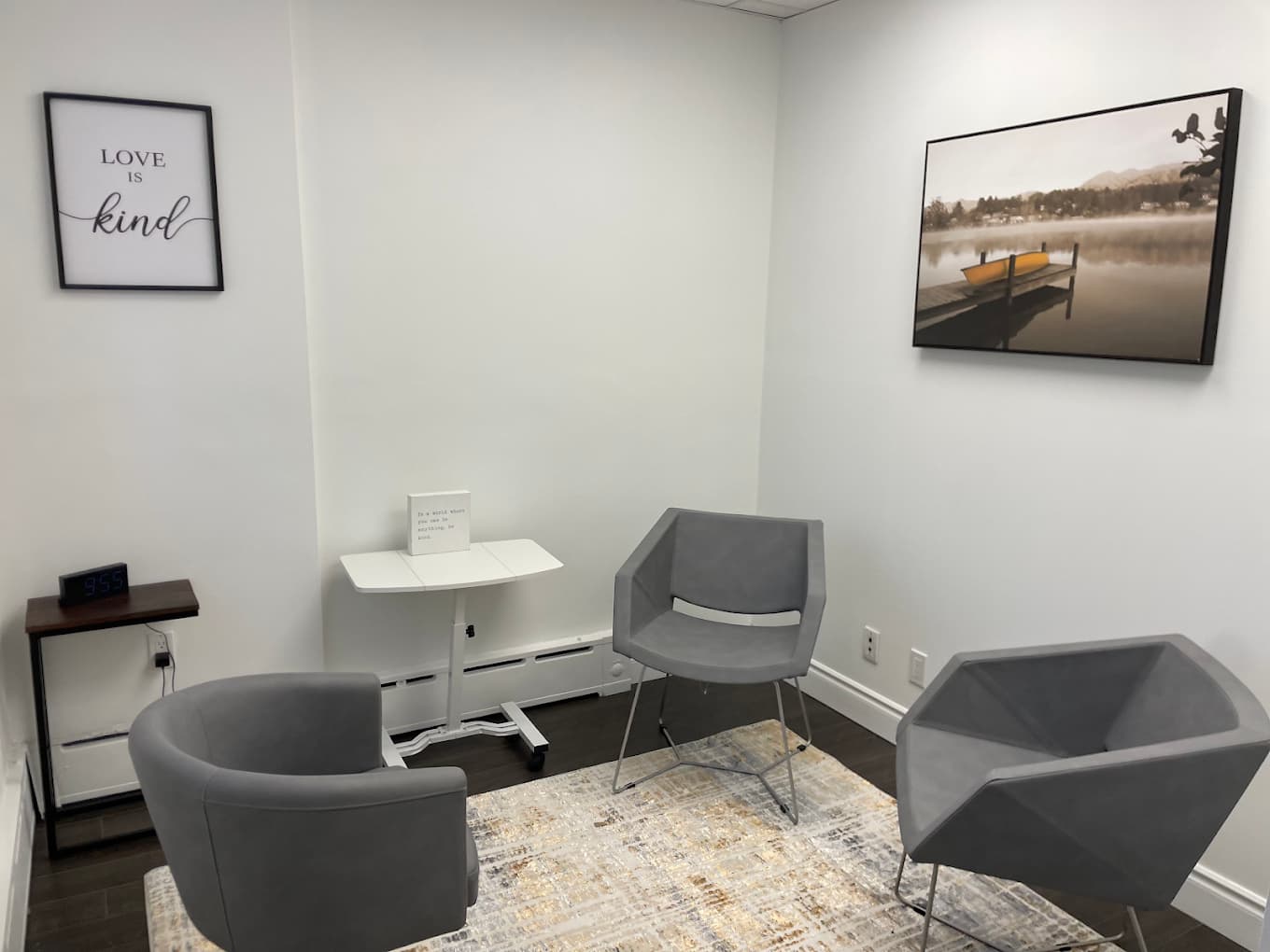
You can have weekly sessions, in person at Avenue Road or Merton Street, or online from wherever you are in Ontario.
-
Checking it is working
Your therapist reviews progress with you openly. If something is not working, we change the approach or find you a better fit on the team.
Therapy for Anxiety
We offer a safe and supportive environment – Contact us today.


How Anxiety Therapy Works at Toronto Family Therapy
Most of our anxiety work is built on Cognitive Behavioural Therapy (CBT). In practice that means less time on your childhood and more time on what happened this week.
The early sessions map the pattern. What triggers the anxiety, what thoughts follow, what you do to make the feeling stop, and how that response quietly makes the next episode more likely. Once you can see the loop, you can start testing your way out of it, usually with something small to try between sessions.
If your anxiety traces back to something older, or sits alongside a loss, a difficult relationship, or a separation, we work with that too.
When anxiety runs through the family
Anxiety rarely stays in one person.
An anxious parent often has an anxious child, and both of them usually
know it. In couples it can look like something else entirely, with one
partner needing constant reassurance while the other goes quiet to
avoid setting anything off.
When a child stops wanting to go to school,
the whole household reorganizes around it inside a couple of weeks.
We are a family practice, so we are not limited to treating whoever
booked the appointment. If the useful work is with you on your own, we
do that. If it is with you and your partner, or with your child while
you get parenting support alongside, we can do that too.
Anxiety therapy anywhere in Ontario
Our offices are on Avenue Road and Merton Street in Toronto, and we see clients in person at both. Virtual sessions are available anywhere in Ontario, which matters if you are outside the city, working shifts, or would simply rather not sit in a waiting room.
For anxiety in particular, online sessions work as well as in-person ones for most people. Some find it easier to talk honestly from their own living room.



Take that first step towards a healthier, happier life.
No diagnosis, no referral.
One conversation is enough to understand whether we are the right fit for you.