
How to Help a Child With School Anxiety: Signs, Support, and When to Get Help

For many children, going back to school after a relaxing summer, means adjusting to earlier mornings, getting back into a routine and returning to some academic and social pressure. Some nervousness or even resistance is completely normal. But for other children, worry about school can be much more intense and show up as tears, trouble sleeping, stomachaches or a strong reluctance to attend school.
Understanding the difference between a normal back to school adjustment and school anxiety can help parents know when their children need a little extra support.
Some worry about school is a normal part of growing up. A new teacher, a big test, a friendship wobble, a change of schools. School anxiety in children becomes a concern when the worry grows intense, sticks around, or starts to interfere with attendance, sleep, learning, friendships, or family life.
If you are searching for how to help a child with school anxiety, the short version looks like this: listen to their experience without judgment, watch for patterns and possible stressors, build support at home, bring the school in early, and reach out for professional help if anxiety is disrupting your child’s daily life. The rest of this article walks through each of those steps.
What Is School Anxiety?
School anxiety happens when a child feels worry, fear or distress that is connected to some part of a child’s school experience.
What sits underneath is different for every child. For one, it is academic pressure or perfectionism. For another, a learning difference that makes the classroom feel like a daily test. Friendship trouble, bullying, sensory overload, worry about being away from a parent, a school change, one specific class or teacher, or simply not knowing what the day will hold can all play a part. Often several threads tangle together, which is why there is rarely one neat cause to find.
So how is this different from ordinary back-to-school nerves? There are three things: intensity, persistence, and impact. Nerves fade as a child settles in. However, school anxiety stays and grows, or starts to shrink your child’s world.
When the anxiety becomes overwhelming, some children begin avoiding school altogether. That pattern deserves curiosity and support, not blame. School anxiety is not a label but a signal. Something is making school feel hard for your child, and your job together is to find out what.
Signs Your Child May Be Struggling With School Anxiety
School anxiety in children doesn’t always announce itself directly. It usually shows up in patterns, and those patterns tend to fall into three groups.
Emotional Signs
This is a type of worry that seems outsized for the situation. For example, tearfulness, irritability, or a shorter fuse than usual. Some children become clingy and want a parent close. Others go quiet and pull away from family and friends.
Physical Signs
Physical school anxiety symptoms are among the most common: headaches, stomachaches, nausea, fatigue, trouble falling or staying asleep, and changes in appetite. These complaints often cluster on school mornings and ease on weekends or holidays. The discomfort is still real, and it should be taken seriously. If physical symptoms are new, severe, or ongoing, check in with your child’s doctor or paediatrician first so medical causes can be considered.
Behavioural and School-Related Signs
There are different signs you can observe: Stalling on morning routines. Trouble concentrating. Falling grades. Frequent trips to the school office. Your child may avoid one class, a specific activity, or one part of the building. Or they might have a growing reluctance to attend at all.
But please note that on their own, none of these proves anxiety. Together, over weeks, they sketch a pattern worth paying attention to. If several feel familiar, our article on the signs your child might benefit from therapy is a useful next read.
Start With Curiosity: How to Talk to Your Child About School
When your child is anxious about going to school, the instinct is to reassure: there is nothing to worry about, you will be fine. Reassurance from a calm parent matters, but on its own it rarely reaches the worry.
Instead, try starting with curiosity. You might say: “I can see mornings have been really hard. I want to understand what school feels like for you. Is there a part of the day that feels especially difficult?”
The goal in these conversations is to listen to your kid, name the feeling together, and understand what might be triggering it. You are not running an interrogation or a debate, and you do not need to fix everything tonight.
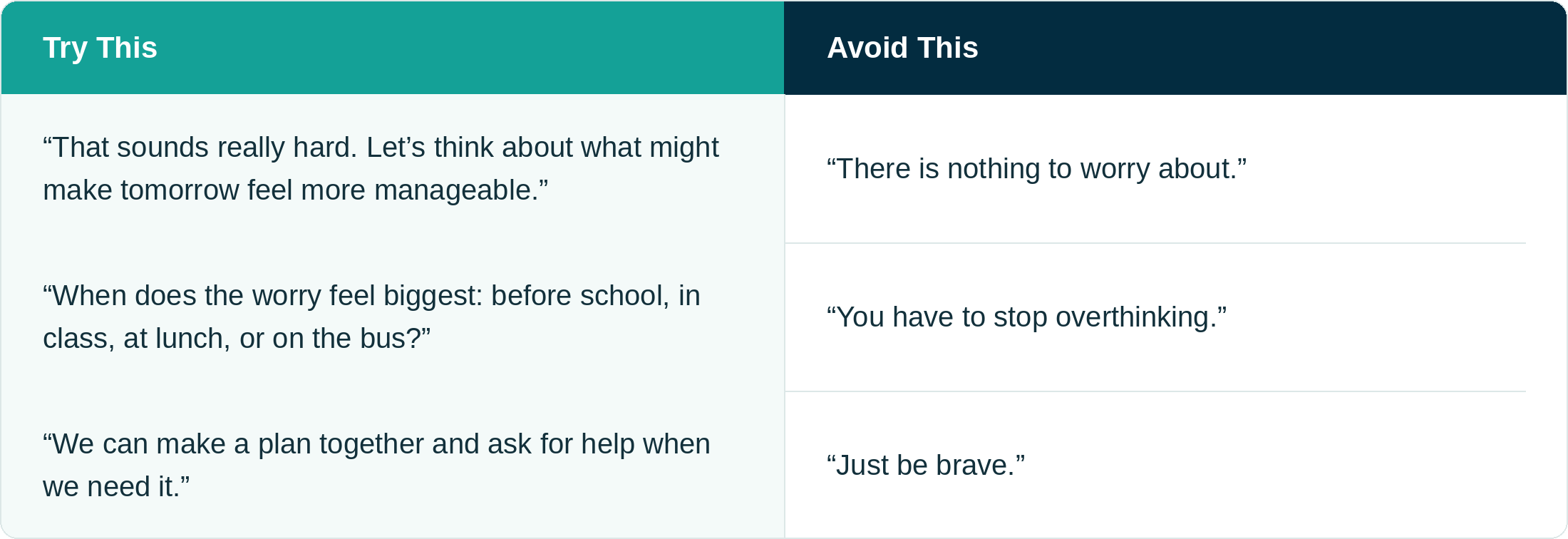
Reassurance works best when it does two things at once: acknowledges your child’s experience and expresses confidence that they can build coping skills. Children’s Mental Health Ontario offers parents similar guidance: stay calm and supportive, take concerns seriously, and help your child develop strategies they can use in different settings.
One of the first questions I ask parents is which part of the school day feels hardest for their child. The answer is almost never all of it. Once we can name the moment, the drop-off, a particular class, the lunchroom, we have somewhere real to start.
Joanna Seidel, MSW, RSW, Acc.FM, Clinical Director at Toronto Family Therapy & Mediation
Create a School Anxiety Support Plan at Home
Think of this as a flexible plan you adjust as you learn. It is never a prescription that guarantees a calm school day.
You can first start with predictability. Regular times for sleep, meals, and getting ready. Lower the background noise of the day. Transitions deserve special care: a short, consistent goodbye routine at drop-off often helps more than a long pep talk.
Keep school mornings light and practical. Heavy conversations about the worry itself usually go better after school or on the weekend, when your child is settled enough to think.
Practice one portable coping tool. There are different tools like slow breathing, grounding through the five senses, writing or drawing the worry, naming one trusted adult at school they can go to. At the end of the day, one well-practised tool beats five half-learned ones.
Small choices help too. Picking tomorrow’s clothes or packing the bag the night before gives your child a sense of agency without making attendance a burden they carry alone.
Then play worry detective together. Keep a simple diary of when the worry shows up, what your child notices in their body, what they fear might happen, and what helped even a little. Over a couple of weeks, you will see that the patterns appear. They feel anxiety only on gym days, or before presentations, maybe in one particular class, or when a certain friendship is rocky.
We should give one caution, though. Rewards, punishments, screen limits and rigid step-by-step exposure plans are sometimes offered as universal fixes, but they are not. If anxiety is significant, decisions about attendance and any return-to-school plan belong in a conversation with your child’s healthcare provider, a mental health professional and the school.
Partner With the School Early
You do not have to manage this alone, and neither does your child. Schools deal with anxiety more often than most parents realize, and they can put real supports in place once they know what is happening.
Make sure you reach out early rather than waiting for worry to persist. . The classroom teacher is often the natural first call in these situations. Depending on the school, a social worker, guidance counsellor or principal may be involved too. Share what you are observing and hold back on conclusions. “She cries most mornings and asks to call home after lunch” is better than just saying “she hates your class.”
Before a school meeting, jot down four things:
- What you are seeing at home
- What your child says is difficult
- The times or situations when the anxiety peaks
- What has helped, even a little
From there, ask which parts of the school day are hardest and build a plan around those specific moments. It might be a predictable morning check-in, a designated calm space, a trusted adult your child can go to, advance notice when the routine changes, a bit of peer support or an agreed way to rejoin class after a break.
Whatever you land on has to fit your child. And where they are old enough, let them help shape it. Children follow plans they had a hand in making.
When School Anxiety Leads to Avoidance
Sometimes anxiety builds until going to school stops being possible. Clinicians have names for it, such as school avoidance or school refusal anxiety, but the name matters far less than what sits underneath it. A child is in enough distress that school feels out of reach some days and sometimes most days.
This is not truancy, and it is not wilful misbehaviour. Peer-reviewed research suggests roughly 1 to 5 per cent of school-aged children experience school refusal, and anxiety is one of the most common threads running through it.
Time also matters here. For many children, the longer they are away, the harder walking back through those doors becomes, which is why early collaboration with the school and the right professionals is so valuable.
Some children need a gradual, individualized plan for returning. No fixed timetable fits every child, and no plan should be built before understanding what is driving the anxiety. A workable plan reflects the reasons behind it, your child’s age and stage, their health needs, their safety, and the realities of their particular school.
When Should You Seek Professional Support?
Professional support may be worth exploring when anxiety is severe, worsening, or persistent or when it is interfering with school attendance, sleep, friendships, family life, or the ordinary activities your child used to enjoy.
Two kinds of help matter. Your child’s doctor or paediatrician can rule out medical contributors and is a sensible early stop, especially when physical symptoms are prominent. A qualified child mental-health professional can then help your family understand the pattern and build coping strategies that fit your child.
Trust your instincts as a parent. You know your child’s baseline better than anyone, and “this is not like them” is a good enough reason to ask questions.
How Toronto Family Therapy Can Help
Our team offers child therapy and counselling in Ontario where children can explore what school feels like in an age-appropriate, supportive setting. Depending on your child’s age and needs, sessions may involve play, art, or talk, and caregivers are part of the picture rather than outside it. You can read more about parent involvement in child therapy and why it matters.
Where appropriate, and always with your consent, our clinicians can coordinate with other people who are supporting your child, including their school. Therapy cannot promise a particular outcome and it may look different for every family. What it can do is help you understand what is happening and respond with a steadier hand.
If you have been searching for school anxiety help in Toronto and across Ontario, and if you are unsure where to begin, a conversation with our team is a low-pressure first step.
You Do Not Have to Figure This Out Alone
Your child does not need to push through school anxiety alone, and you do not need to solve it alone either.
What helps a child with school anxiety is steady and simple: listen carefully, watch for patterns, build support at home and at school, then reach out when the anxiety is disrupting your child’s life.
If your child is finding school overwhelming, Toronto Family Therapy & Mediation can help you and your family understand what is happening and build practical, compassionate support. Contact us to learn more about child therapy and counselling in Toronto.
Frequently Asked Questions About School Anxiety
Can anxiety cause a child to miss school?
Yes. When anxiety is strong enough, it can make regular attendance difficult and for some children it builds into a pattern of school avoidance. The most useful early moves are understanding what is driving the anxiety, involving the school, and bringing in your child’s healthcare provider or a mental-health professional sooner rather than later.
What are the physical signs of school anxiety in children?
Stomachaches, headaches, nausea, fatigue, sleep problems, and appetite changes are the most common, and they often cluster on school mornings while disappearing on weekends. The discomfort is real even when anxiety is the source, so take it seriously and ask your child’s doctor to consider physical causes, especially if symptoms are new, severe or ongoing.
What should I say when my child says they do not want to go to school?
Lead with validation and curiosity. Say something like: “That sounds really hard. Can you help me understand which part feels the worst?” When a child is anxious about going to school, feeling heard usually has to come before problem-solving. From there, you can build a small plan together and bring in help where you need it. Avoid dismissing the worry or shaming them for it.
Should I force my child to go to school if they are anxious?
There is no blanket answer to this, and know that pressure alone can deepen distress when the cause is not yet understood. Your child’s safety and the triggers behind the anxiety matter most. If anxiety is significant or attendance is already affected, start working with your child’s healthcare provider, a mental-health professional and the school on a plan rather than going it alone.
Can child therapy help with school anxiety?
It can. Because therapy may help a child understand their feelings, practise age-appropriate coping skills, and give caregivers practical ways to respond at home. However, it is one part of how to help a child with school anxiety rather than a guaranteed fix, and the right support depends on your child and what is driving the worry.
This article is for educational purposes and is not a substitute for medical or mental-health assessment, diagnosis or treatment.

Leave a Reply
Want to join the discussion?Feel free to contribute!